Preview this course
₹199 ₹349 43% off
incl. GST
left at this price!
Sign up to buy Already a member? Log in

7-day money-back guarantee

Bestseller Recently updated Business · Finance

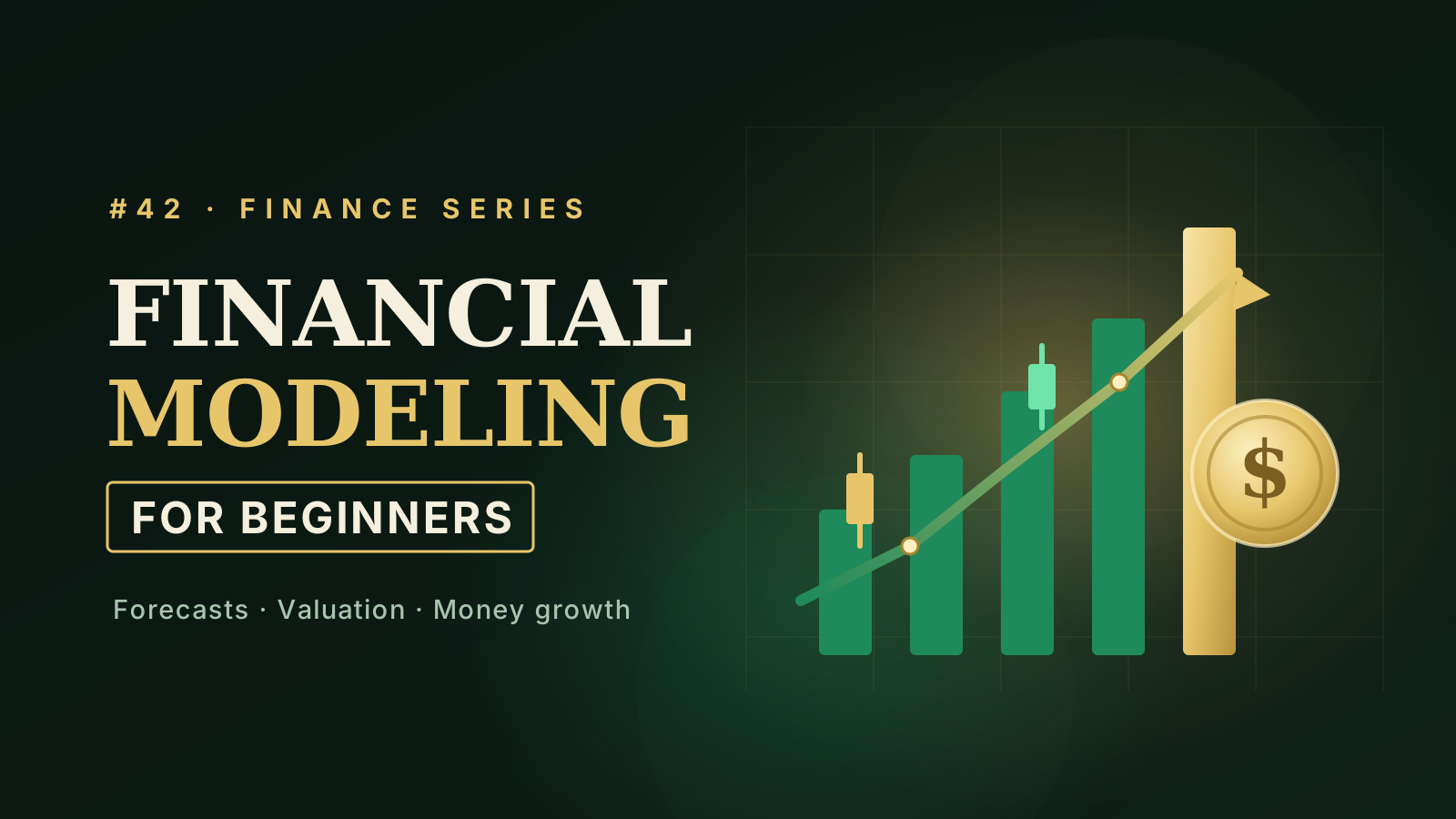
Financial Modeling for Beginners — Complete Course

From zero spreadsheet skills to building an analyst-ready, three-statement valuation model in Excel — forecasting, DCF, comparables, scenarios, and presenting like a working analyst.

3.8 (27 ratings) Created by Adrian Vance
Beginner 159 lessons 21h 39m Updated Jun 2026 English
Preview this course
₹199 ₹349 43% off
incl. GST
left at this price!
Sign up to buy Already a member? Log in

7-day money-back guarantee

What you'll learn

Navigate and format Excel efficiently with the shortcuts and structure analysts use every day
Read and interpret the income statement, balance sheet, and cash flow statement — and how they connect
Build a fully integrated, error-checked three-statement model from scratch
Forecast revenue, costs, working capital, and capital expenditure with defensible assumptions
Value a business with discounted cash flow (DCF), comparable companies, and precedent transactions
Run scenario and sensitivity analysis to stress-test your conclusions
Present a clear, well-formatted output package and recommendation like a working analyst
Build a portfolio-ready capstone model and prepare for financial-analyst interviews

This course includes

21h 39m of on-demand content
159 lessons across 21 sections
Access on mobile and desktop
Certificate of completion
Lifetime access
Curriculum

Course content

21 sections · 159 lessons · 21h 39m

Welcome to the Course Preview 10 min
Course Files & Setup Preview 9 min
Section Quiz · Welcome & Course Roadmap 15 min

Navigating Excel Like a Pro 9 min
Cell References Explained 9 min
Essential Excel Formatting 9 min
Core Excel Functions 9 min
Logical Functions 9 min
Lookup Functions 9 min
Working With Dates 9 min
Useful Keyboard Shortcuts 9 min
Data Tools You'll Actually Use 9 min
Excel Practice Exercise 12 min
Section Quiz · Excel Foundations for Financial Modeling 15 min

Introduction to Financial Statements 9 min
The Income Statement 10 min
The Balance Sheet 10 min
The Cash Flow Statement 10 min
How the Three Statements Connect 10 min
Accrual vs. Cash: Where Profit ≠ Cash 10 min
Reading a Real Company's Statements 10 min
Statements Recap & Self-Check 9 min
Section Quiz · Understanding Financial Statements 15 min

What Makes a Good Financial Model? 9 min
Model Structure & Layout 9 min
Inputs, Calculations & Outputs 9 min
Color Coding Standards 9 min
Avoiding Common Modeling Mistakes 9 min
Building Models Others Understand 9 min
Formula Auditing & Error-Checking 10 min
Section Quiz · Financial Modeling Best Practices 15 min

Setting Up the Model Framework 9 min
Importing Historical Financial Data 9 min
Organizing Historical Statements 10 min
Creating Assumption Inputs 9 min
Building Supporting Schedules 10 min
Model Integrity Checks 9 min
Mini Project: Simple Company Model 10 min
Section Quiz · Building Your First Financial Model 15 min

Why Forecasting Matters 9 min
Historical Trend Analysis 10 min
Revenue Growth Assumptions 10 min
Volume and Price Drivers 10 min
Segment-Based Revenue Forecasts 10 min
Scenario Forecasting 10 min
Revenue Forecast Practice 12 min
Section Quiz · Forecasting Revenue 15 min

Understanding Cost Drivers 9 min
Cost of Goods Sold Forecasting 10 min
Operating Expense Forecasting 10 min
Fixed vs Variable Costs 10 min
Margin Analysis 10 min
Building the Full Income Statement Forecast 11 min
Section Quiz · Forecasting Costs and Expenses 15 min

Forecasting Working Capital 10 min
Accounts Receivable 9 min
Inventory 9 min
Accounts Payable 9 min
Other Assets and Liabilities 9 min
Balancing the Balance Sheet 10 min
Balance Sheet Forecast Exercise 10 min
Section Quiz · Forecasting the Balance Sheet 15 min

Cash Flow Forecasting Basics 9 min
Linking Net Income 8 min
Non-Cash Adjustments 9 min
Working Capital Effects 10 min
Capital Expenditures 9 min
Financing Activities 9 min
Completing the Three-Statement Model 10 min
Section Quiz · Forecasting the Cash Flow Statement 15 min

Depreciation Schedule 10 min
Capital Expenditure Schedule 9 min
Debt Schedule 10 min
Interest Expense Calculations 10 min
Revolver Mechanics 11 min
Linking Supporting Schedules 10 min
Section Quiz · Building Supporting Schedules 15 min

Ratio Analysis Basics 9 min
Profitability Ratios 10 min
Liquidity Ratios 9 min
Efficiency Ratios 10 min
Leverage Ratios 10 min
Trend Analysis 9 min
Building a KPI Dashboard 9 min
Section Quiz · Financial Analysis Fundamentals 15 min

What Is Valuation? 9 min
The Main Valuation Methods 10 min
Enterprise Value vs Equity Value 10 min
Valuation Terminology Explained 9 min
Valuation Framework Overview 10 min
Section Quiz · Introduction to Business Valuation 15 min

Understanding Free Cash Flow 9 min
Calculating Free Cash Flow 9 min
Understanding Discount Rates 9 min
Introduction to WACC 9 min
Calculating WACC 10 min
Terminal Value Methods 10 min
Building a Complete DCF Model 11 min
Sensitivity Analysis 9 min
Interpreting DCF Results 9 min
Section Quiz · Discounted Cash Flow (DCF) Valuation 15 min

Understanding Trading Comparables 9 min
Selecting Comparable Companies 9 min
Collecting Market Data 9 min
Valuation Multiples 9 min
Building a Comparable Company Table 10 min
Deriving Valuation Ranges 10 min
Section Quiz · Comparable Company Analysis 15 min

What Are Precedent Transactions? 9 min
Finding Relevant Transactions 9 min
Transaction Multiples 10 min
Building a Transaction Analysis Table 10 min
Transaction vs Trading Multiples 10 min
Section Quiz · Precedent Transaction Analysis 15 min

Best, Base and Worst Case 9 min
Excel Data Tables 9 min
Sensitivity Matrices 10 min
Scenario Analysis 10 min
Interpreting Model Outputs 9 min
Presenting Recommendations 9 min
Section Quiz · Sensitivity, Scenarios & Decision Making 15 min

Project Overview 9 min
Gathering Company Data 9 min
Building Historical Statements 10 min
Forecasting Operations 10 min
Building Supporting Schedules 10 min
Completing the Three-Statement Model 10 min
Performing DCF Valuation 11 min
Performing Comparable Analysis 10 min
Final Valuation Conclusion 10 min
Quality Checks & Model Review 10 min
Section Quiz · Building an Analyst-Ready Valuation Model (Capstone) 15 min

Creating Professional Charts 10 min
Building Executive Summaries 9 min
Presenting Key Assumptions 9 min
Writing Valuation Conclusions 9 min
Creating a Simple Investor Presentation 9 min
Section Quiz · Presenting Results Like an Analyst 15 min

Common Interview Questions 9 min
Financial Modeling Tests Explained 9 min
Analyst Workflow and Expectations 9 min
Building a Modeling Portfolio 9 min
Next Steps in Your Finance Career 9 min
Section Quiz · Career Skills for Aspiring Financial Analysts 15 min

What You've Accomplished 9 min
Common Mistakes to Avoid 10 min
Continuing Your Learning Journey 10 min
Final Course Project Submission 9 min
Congratulations & Next Steps 9 min
Section Quiz · Course Wrap-Up 15 min

Excel Shortcut Cheat-Sheet 6 min
Excel Formulas Reference 7 min
Financial Ratios Reference 7 min
Template: Three-Statement Starter 6 min
Template: Working-Capital Schedule 6 min
Template: DCF Valuation 7 min
Template: Comparable Companies Table 6 min
Glossary of Financial Modeling Terms 8 min

Requirements

  • Microsoft Excel 2021 or Microsoft 365 (XLOOKUP and dynamic arrays are used; Google Sheets notes provided where they differ)
  • Basic arithmetic — no prior finance or advanced Excel knowledge required
  • A few hours per week to follow the lessons and build alongside the practice files

Description

Financial modeling sounds intimidating, but underneath the jargon it is a single, learnable skill: turning a set of assumptions about a business into numbers about its future. This beginner-friendly, hands-on course assumes no prior finance or advanced Excel knowledge and takes you all the way from a blank spreadsheet to an analyst-ready, three-statement valuation model.

You will build everything yourself, step by step. Every concept is introduced in plain language, demonstrated in Excel, and reinforced with a downloadable practice file and a section quiz. By the end you can build a complete integrated model, value a company three different ways, stress-test your conclusions, and present a recommendation the way a working analyst does.

How the course is organized

The 20 sections move through five phases:

  • Foundations — Excel fluency, reading the income statement / balance sheet / cash flow statement, and the modeling best practices that keep a model clean and auditable
  • Build the Model — a complete, integrated three-statement model with revenue, cost, working-capital, and capex forecasts plus supporting schedules
  • Analyze & Value — ratio analysis, discounted cash flow (DCF), comparable companies, and precedent transactions
  • Decide & Present — scenario and sensitivity analysis, and a professional, well-formatted output package
  • Capstone & Career — a portfolio-ready valuation model built end to end, plus the skills and interview prep to land an analyst role

A Resources & Downloads section collects the templates, cheat-sheets, and a glossary so the reference material you need is always one click away.

Who it's for

Students and career-switchers targeting investment banking, equity research, corporate finance, FP&A, or consulting; founders and operators who want to model their own business; and anyone who wants to genuinely understand how companies are forecast and valued. All you need is Microsoft Excel and basic arithmetic — we teach the rest.

Your instructor
A

Adrian Vance

Financial Modeling & Valuation · 13 yrs · CFA, ex-Investment Banking & Equity Research

3.8 course rating 1 courses

Adrian spent 13 years in investment banking and equity research, building three-statement models and DCF valuations for IPOs, M&A, and coverage on public companies. A CFA charterholder, he has trained scores of new analysts to go from blank spreadsheet to an interview-ready model — and is convinced almost anyone can learn it once the jargon is stripped away. He teaches modeling the way it is actually done on the desk: clean inputs, formulas you can audit, and a number you can defend in a room.

3.8 course rating · 27 ratings

M
Merritt Schneider
9 months ago

Easily one of the best courses I have taken. The explanations are crystal clear and every concept builds logically on the last.

Helpful?
P
Prof. Pearlie Funk DVM
6 months ago

It is okay. Helpful if you are starting out, though intermediate learners may not get as much from it.

Helpful?
J
Janelle Thiel
1 year ago

Some solid moments, some filler. Worth it on a discount, perhaps not at full price.

Helpful?
J
Juanita Grant
3 months ago

Top notch content and a wonderful teaching style. I would happily pay double for this.

Helpful?

Frequently asked questions

Yes — once you enroll, the course is yours to revisit forever. New revisions and bonus lessons are added at no extra cost.

Finish every lesson and you'll unlock a shareable certificate you can post on LinkedIn or include with job applications.

If the course isn't a fit, request a refund within 7 days of purchase — no questions asked.

Code, slides, and worksheets are downloadable on each lesson page. Videos stream from our CDN so you can watch on any device.

Each course states its level in the hero. If you're comfortable with the prerequisites listed, you're ready to start.

Students also bought

₹199 ₹349
Sign up to buy