Preview this course
₹299 ₹699 57% off
incl. GST
left at this price!
Sign up to buy Already a member? Log in

7-day money-back guarantee

Bestseller Recently updated AI · Technology

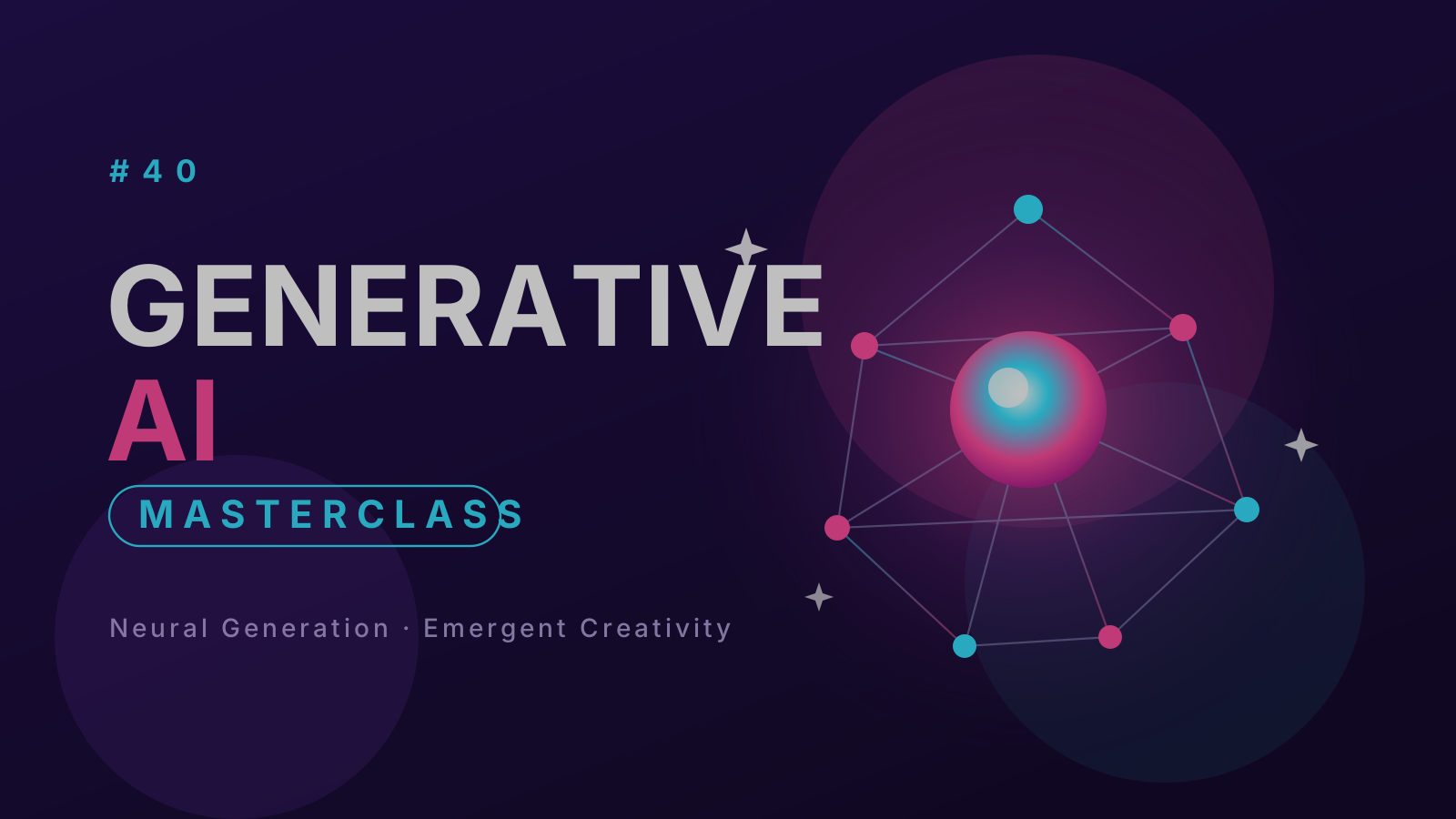
Generative AI Masterclass

Build LLM Apps from Zero to Hero — the complete, hands-on path from "what is a token?" to designing, evaluating, and shipping a real Generative AI system.

3.9 (109 ratings) Created by Marcus Chen
Advanced 118 lessons 29h 51m Updated Jun 2026 English
Preview this course
₹299 ₹699 57% off
incl. GST
left at this price!
Sign up to buy Already a member? Log in

7-day money-back guarantee

What you'll learn

Build an accurate mental model of how LLMs work — tokens, training, reasoning models, and their honest limits
Engineer reliable prompts and structured, machine-readable output
Drive LLMs from code: chat, streaming, function calling, and cost control
Ground answers in private knowledge with embeddings, vector search, and a production RAG pipeline
Build agents that reason, call tools, and connect to real systems via MCP — and coordinate as teams
Fine-tune and run open models, and add vision, image, and speech with multimodal AI
Evaluate, secure, deploy, monitor, and scale a real GenAI application to production

This course includes

29h 51m of on-demand content
118 lessons across 19 sections
Access on mobile and desktop
Certificate of completion
Lifetime access
Curriculum

Course content

19 sections · 118 lessons · 29h 51m

The 2026 LLM Ecosystem & How to Use This Course 14 min
Section Quiz · Welcome & Course Roadmap 12 min

The Evolution of AI 14 min
Machine Learning in One Lesson 16 min
Neural Networks Demystified 16 min
How Models Actually Learn 15 min
From Neural Nets to Transformers 16 min
Section Quiz · Foundations: AI, ML & Deep Learning 15 min

Predictive vs Generative Models 13 min
The Model Families 15 min
Inside the Transformer 17 min
Foundation Models & Emergence 14 min
Generative AI Use Cases 13 min
Section Quiz · Understanding Generative AI 15 min

What Is an LLM? 14 min
Tokens & Context Windows 16 min
How LLMs Are Trained 15 min
Reasoning Models & Extended Thinking 15 min
The LLM Landscape 14 min
Capabilities, Limits & Hallucination 14 min
Section Quiz · Large Language Models Explained 18 min

Anatomy of a Prompt 14 min
System vs User Prompts & the Instruction Hierarchy 14 min
Zero / One / Few-Shot Prompting 14 min
Chain-of-Thought & Self-Consistency 16 min
Structured Output Generation 16 min
Prompting Reasoning Models & Prompt Caching 15 min
Prompt Debugging Workshop 16 min
Section Quiz · Prompt Engineering Mastery 21 min

How LLM APIs Work 14 min
Your First LLM Call (OpenAI SDK) 14 min
Building a Chat App 16 min
Streaming Responses 14 min
Structured Outputs & Function Calling via API 18 min
Cost & Token Optimization 16 min
Project: Sage Chat v1 30 min
Section Quiz · Working with LLM APIs 18 min

What Are Embeddings? 13 min
Similarity & Distance Metrics 14 min
Vector Databases Explained 15 min
The Vector DB Landscape 14 min
Build It: Semantic Search over Brightpath Docs 20 min
Section Quiz · Embeddings & Vector Databases 12 min

Why RAG (vs Long Context vs Fine-Tuning) 15 min
RAG Architecture End-to-End 15 min
Chunking Strategies 16 min
Build a PDF Chatbot 24 min
Advanced RAG 18 min
Agentic RAG & RAG Evaluation 16 min
Project: Sage Tutor 30 min
Section Quiz · Retrieval-Augmented Generation (RAG) 15 min

Why a Framework? LangChain Fundamentals 15 min
LCEL & the Runnable Interface 16 min
Building Workflows 15 min
Memory & State 15 min
Intro to LangGraph 17 min
The Framework Landscape 14 min
Section Quiz · LangChain, LCEL & LLM Frameworks 18 min

What Is an Agent? 14 min
The Agent Loop (ReAct) 15 min
Tool & Function Calling 18 min
Model Context Protocol (MCP) 17 min
Building an AI Research Agent 22 min
Agent Memory & Planning 16 min
Multi-Agent Systems 18 min
Project: Sage Research 32 min
Section Quiz · AI Agents, Tool Calling & MCP 21 min

Prompting vs RAG vs Fine-Tuning 14 min
Dataset Preparation 16 min
Fine-Tuning a Hosted Model 20 min
Parameter-Efficient Fine-Tuning 16 min
Running Open Models Locally 18 min
Project: Fine-Tune Sage's Triage Classifier 28 min
Section Quiz · Fine-Tuning & Open Models 15 min

The Multimodal Landscape 13 min
Vision & Document Understanding 16 min
Image Generation 16 min
Speech AI 15 min
Realtime & Voice Assistants 16 min
Project: Sage Studio 28 min
Section Quiz · Multimodal AI Applications 15 min

Evaluating LLM Apps 15 min
Evaluation Frameworks 16 min
Building an Eval Suite 18 min
Safety & Guardrails 18 min
Responsible AI 15 min
Project: Evaluate & Harden Sage 28 min
Section Quiz · Evaluation & Guardrails 15 min

Architecture for Production GenAI 16 min
Deployment Options 15 min
CI/CD for LLM Apps 16 min
Monitoring & Observability 16 min
Scaling, Caching & Reliability 16 min
Project: Deploy Sage 30 min
Section Quiz · Production Deployment 15 min

Context Engineering 18 min
Model Routing & Fallbacks 16 min
Agentic Workflow Orchestration 17 min
Enterprise Knowledge Systems 16 min
Caching & Cost at Scale 15 min
LLM System Design Interview Patterns 20 min
Section Quiz · Advanced LLM System Design 18 min

AI Customer Support Assistant 30 min
AI Resume & Interview Coach 30 min
AI Research Assistant 30 min
AI Content Generation Platform 30 min

Designing the System 30 min
Build & Integrate 40 min
Ship & Present 30 min

Emerging Trends 14 min
The GenAI Career Map 16 min
Building Your AI Portfolio 16 min
Next Steps & Resources 14 min
Section Quiz · Future of GenAI & Career Roadmap 6 min

Final Assessment & Certification 12 min

Requirements

  • Basic comfort with Python (functions, classes, pip) for the hands-on builds
  • Familiarity with calling an HTTP/JSON API helps but is not required
  • An LLM API key from any major provider to run the worked examples

Description

From "what is a token?" to a shipped product

Most courses teach Generative AI in disconnected toy examples. This one grows a single real product across every section, so your skills compound instead of resetting. You'll build Sage — a production-shaped AI assistant for the fictional startup Brightpath — one layer at a time, ending with a system that retrieves from private docs, uses tools, generates content, is evaluated and secured, and runs in production.

Six phases, eighteen sections

  1. Foundations (Sections 1–4) — get oriented, then build an accurate mental model of AI, ML, generative models, and LLMs: tokens, training, reasoning models, and honest limits.
  2. Prompting & APIs (Sections 5–6) — make models behave reliably, then drive them from code and ship Sage Chat.
  3. Knowledge & Retrieval (Sections 7–9) — embeddings, vector search, RAG, and frameworks — ground Sage in private knowledge and make it composable.
  4. Agents & Customization (Sections 10–12) — agents with tools and MCP, fine-tuning and open models, and multimodal features.
  5. Production & Scale (Sections 13–15) — evaluate, secure, deploy, monitor, and design enterprise-grade systems.
  6. Portfolio & Career (Sections 16–18) — standalone builds, the integrated capstone, and the path to a GenAI career.

Build, don't just watch

Each section ends with a hands-on checkpoint that adds a concrete capability to Sage. Along the way you ship seven standalone projects plus a capstone, and every section closes with a quiz so you can check your understanding before moving on. A final assessment ties the whole journey together.

Who this is for

Developers and technical builders who want to go from curiosity to competence in Generative AI. You should be comfortable reading basic Python; everything else — prompting, RAG, agents, fine-tuning, multimodal, evaluation, deployment — is taught from the ground up.

Your instructor
M

Marcus Chen

System Design & Distributed Systems · 14 yrs · Ex-Amazon, Staff Engineer

3.9 course rating 4 courses

Marcus has spent 14 years building the kind of distributed systems that quietly run the internet — order pipelines, multi-region data stores, and the boring-but-critical plumbing in between. He led capacity and reliability work on systems serving hundreds of millions of users at Amazon, and now teaches the trade-offs behind the diagrams, not just the diagrams themselves.

3.9 course rating · 109 ratings

P
Prof. Edwin Yundt
3 months ago

Very good overall. The fundamentals are explained clearly, though some examples felt slightly dated.

Helpful?
D
Dr. Cassie Grady
1 year ago

The best money I have spent on learning this year. Clear, modern, and no fluff.

Helpful?
P
Prof. Lou Pfeffer
1 year ago

Clear and practical. Most of it was excellent; one or two lessons could use a refresh.

Helpful?
P
Prof. Bell Yundt
5 months ago

Some solid moments, some filler. Worth it on a discount, perhaps not at full price.

Helpful?

Frequently asked questions

Yes — once you enroll, the course is yours to revisit forever. New revisions and bonus lessons are added at no extra cost.

Finish every lesson and you'll unlock a shareable certificate you can post on LinkedIn or include with job applications.

If the course isn't a fit, request a refund within 7 days of purchase — no questions asked.

Code, slides, and worksheets are downloadable on each lesson page. Videos stream from our CDN so you can watch on any device.

Each course states its level in the hero. If you're comfortable with the prerequisites listed, you're ready to start.

Students also bought

₹299 ₹699
Sign up to buy